
Scottish Borders Guide

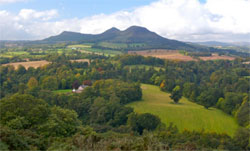 The Scottish Borders has for a long time been a gateway into Scotland from the south. In the past the border of England and Scotland has moved north and south during the feudal times. Now the region is a beautiful place to visit, with its breath‑taking landscape of rolling hills and the River Tweed stretching from east to west. The Scottish Borders is scattered with friendly small towns and some of the most important historic monuments in Scotland which proved their fight for independence.
 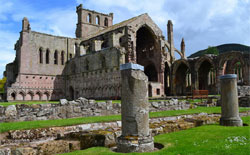 In the award‑winning town of Melrose is the great Melrose Abbey. The Abbey was founded in the 12th century by monks and once part of a great monastery set in the solitude of the Tweed Valley. Nowadays it is a quaint town with friendly inns, restaurants and of course the beautiful ruins of the Abbey. From the surrounding view you can imagine how it was during the middle ages. Destroyed by the English and rebuilt by the Scottish during the Wars of Independence. During these times one of Scotland's great heroes, Robert the Bruce, took a fondness to the structure and now it is here where Robert the Bruce's heart is buried (his body is buried at Dunfermline Abbey).
Melrose is on the 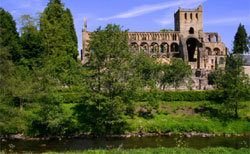 Borders Abbeys Way which is a 65‑mile circular trail including three other historic Abbeys: Jedburgh, Kelso, and Dryburgh. All Abbeys were built during the reign of King David I to demonstrate to the English that Scots could also create grand religious buildings, but now all are in ruins. Floors Castle in Kelso is the largest inhabited castle in Scotland. William Wallace's statue can also be found in Kelso. On the way to Dryburgh is Scott's View, made famous by Sir Walter Scott for his favourite view of the Eildon Hills. On the trail is also the town of Selkirk, where every year the Common Riding is held; an annual celebration where about 400 riders commemorate the brave men who fought alongside William Wallace and Robert the Bruce.
 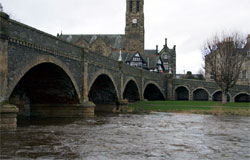 To the west is the town of Peebles, one of the bigger towns in the Borders region. Another historic town with churches and a castle damaged and rebuilt during the wars between the 12th and 14th centuries. Near Peebles is Glentress Forest, a great place for walking, biking and horse riding. Traquair House is also worth a visit if you have time. Used by the Stuarts as a refuge for priests in the 12th century, it is now a Bed and Breakfast and a Brewery where you can have a sample at the 1745 Cottage Restaurant.
 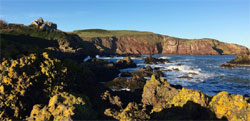 The east is the dramatic coastline of Berwickshire and the grouse moors of the Lammermuir Hills. An ideal place for walking and bird watching.
For more details on touring the Scottish Borders you can request a brochure from the Tourist Board or download a pamphlet.