
Argyll and Bute Guide

 In the heartland of Scotland, Argyll and Bute is one of 32 council areas divided in 1996. Included are such areas as Oban, the Inner Hebrides, Inveraray, Lochgilphead, Tarbert, Islay and Jura. The 2nd biggest council area in size in Scotland yet the 22nd in population. With over 3000 miles of coastline including the islands this is a vast region with grand nature and rural life.
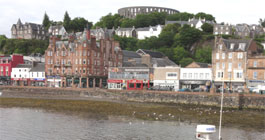
On the west highlands coast is the town of Oban, sitting on a picturesque horseshoe bay port with a hillside backdrop and a replica of the Coliseum (McCaig's Folly) predominately seen in the skyline. This small fishing town is an ideal stop when making your way up north to the highlands or the islands. In town you can visit the Oban Distillery, one of Scotland's oldest sources of single malt scotch whisky. Then take a relaxing walk along the harbour by the many fishmongers. With some of the best seafood in Scotland you must take time to stop for a fish and chip meal. Outside Oban you can take day trips to Dunstaffnage Castle and Taynuilt where you can take a cruise on Loch Etive. 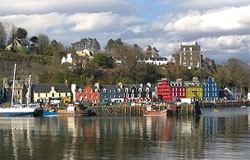 Oban has for a long time been known as Scotland's gateway to the Inner Hebrides Isles. From the ferry terminal you can take a day trip to see Mull, Iona and Staffa. The Isle of Mull is the largest island in the Inner Hebrides, an island full of friendly people and pretty fishing villages. Arriving to the old pier of Craignure you can catch the Isle of Mull Railway train to Torosay Castle; a spectacular 150‑year‑old Scottish baronial style castle surrounded by magnificent and unique gardens. Making your way across the island stop in Tobermory, a fishing harbour with a unique colour scheme on its buildings, probably the most attractive port in Scotland. Tobermory is also home to the only whisky distillery on the island.
From Fionnphort catch another ferry to the neighbouring island of Iona. Iona is the birthplace of religion in Scotland; it is here where St. Columba of the Scots tribe from Ireland landed in AD 563 to start his pilgrimage to spread Christianity. 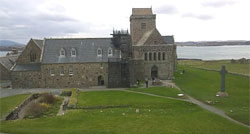 A magical little island, only 3.5 miles long by 1.5 miles wide, surrounded by white sands and turquoise water. Take a walk around the island and discover its ancient abbey (although it is a replica, rebuilt in 849, the original was destroyed by Vikings), and its graveyard, Relig Odhráin, that was the burial place of Scottish kings until the death of Macbeth in 1057. Also the nunnery ruins, Michael Chapel and the Infirmary Museum. From Iona you can also take a short small ferry ride to Staffa which is an uninhabited cliff island with a famous sea‑cave. The Fingal's Cave myth says that it was used by a Celtic warlord to hide from the Norse Vikings. There is a passageway that leads into the cave allowing you to see the spectacular natural rock carvings.
  The ports in Oban and Mull also link to other islands around the Hebrides such as Coll, Tiree, Lismore, Kerrera and also Skye. For more details you can download a tourism pamphlet of Oban and Mull.
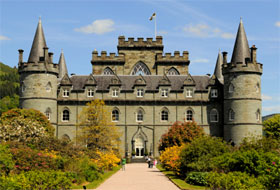
Further inland is Inveraray, a Royal Burgh town, located on the western shore of Loch Fyne. Inveraray Castle is a remarkable and unique piece of architecture incorporating Baroque, Palladian and Gothic. Take a look at the website to see more details.
Back to the lower west highland coast is the Mull of Kintyre, the cradle of early Gaelic culture. Still part of the mainland this narrow peninsula stretches 30 miles to the sea. Paul McCartney created a song serenading this region’s beauty. Campbeltown is the largest town and has a history and landscape of its own; it was the scene of Viking invasions at Saddell and nearby are the stunning beaches of Carradale. Visit the Campbeltown Heritage Centre for an interesting insight into the past life of Campbeltown and the people who lived here in the old days. Also synonymous for its whisky, visit the Springbank Distillery producing three different single malt Scotch whiskies.
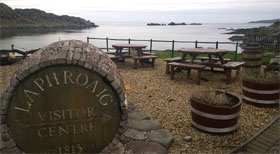 From West Loch Tarbert you can catch a ferry to nearby islands of Islay and Jura. Islay is world renowned for its fine single malt Scotch whisky with their peaty qualities. Some of the most distinctive malts in Scotland, there are nine distilleries on the island. Bowmore Distillery is one of the most popular, its white building unmistakable sitting on the shores of Loch Indaal since 1779. The barley is still hand‑turned using the traditional wooden malt shovel just as the forefathers of the distillery did. Other whiskies distilled on the island are Laphroaig, Lagavulin, Ardbeg, Port Ellen, Bruichladdich, Kilchoman, Caol Ila, and Bunnahabhain. The neighbouring island of Jura also has its own distillery. Placed on the Atlantic Ocean the islands have great scenery to offer as well as an abundance of seabird wildlife and marine life. For more details download a tourism pamphlet of Islay, Jura and Kintyre.
In the centre of the Firth of Clyde lies the tiny Isle of Bute. Only 15 by 5 miles in size, Bute has been used as a holiday destination for Scottish kings and Glaswegians since Victorian times. Rothesay is the main town, the Royal Burgh, with Victorian style architecture on the buildings facing the picturesque bay. With a coastline of beautiful sandy beaches and inland of lush rolling hills and moorlands this is another great island for walking, cycling, fishing and wildlife.